Machine Learning Approaches for Cardiovascular Risk Prediction in Cohort Data
ML & Cardiovascular Risk Prediction
| Year | 2025 |
|---|---|
| Location | IISc |
| Tags | DeepSurv, Random Survival Forests, TCR, single-cell |
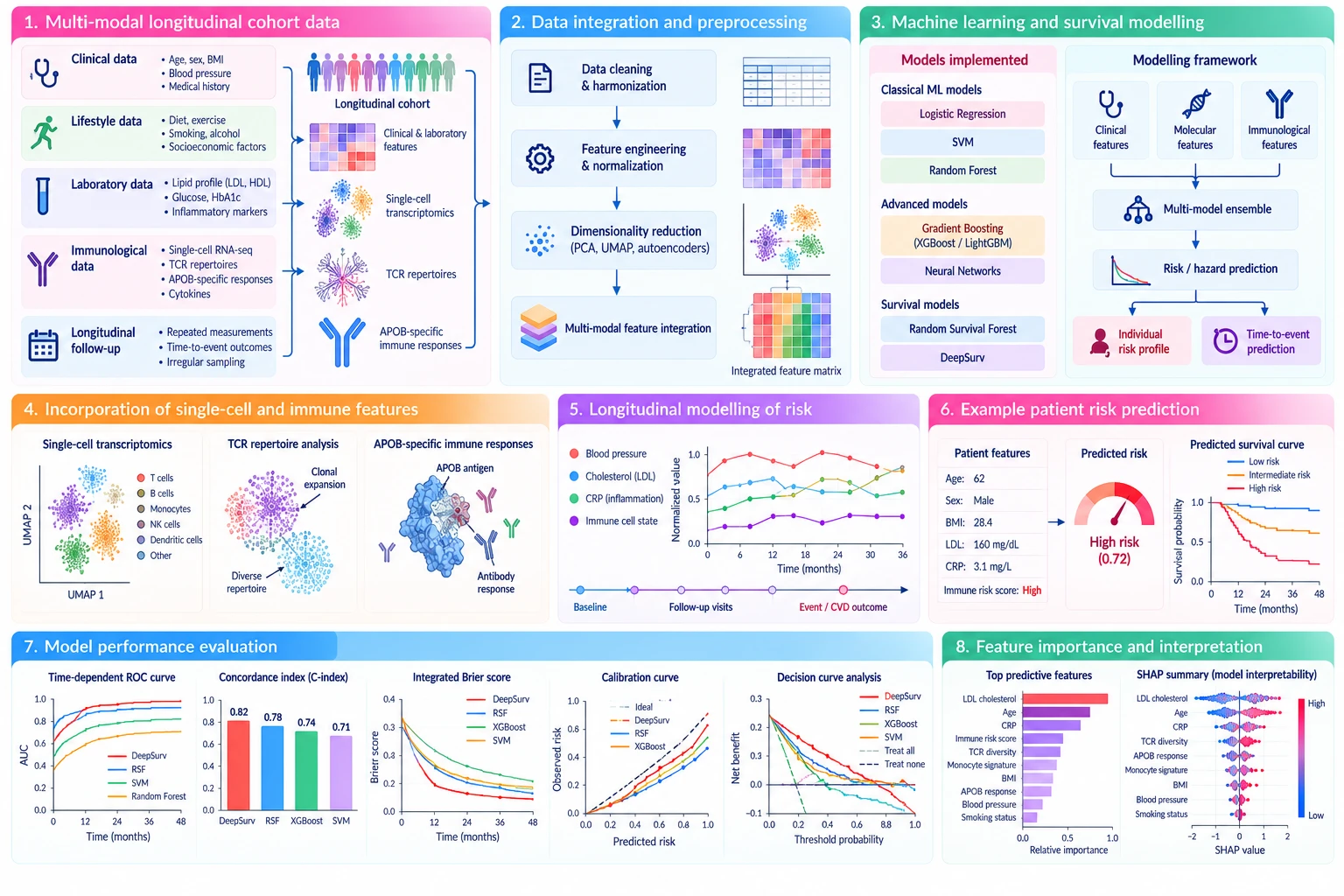
Interpretable risk prediction from longitudinal cohorts, combining clinical, immune and single-cell features in Random Survival Forests and DeepSurv, judged by C-index, Brier score, calibration and decision curves.
Jul 2025 – Sep 2025 at IISc, Bangalore, supervised by Payel Roy.
- 01Data
Longitudinal cohort data combining clinical, lifestyle, laboratory and immunological features, plus single-cell transcriptomic profiles, TCR repertoires and APOB-specific immune responses.
Cohort data, scRNA-seq, TCR repertoires - 02Representation
Dimensionality reduction and representation learning to capture high-dimensional immune states.
Dimensionality reduction, Representation learning - 03Models
Classical and nonlinear models for risk, including time-to-event modelling.
Logistic Regression, SVM, Random Forest, Gradient boosting, Neural networks, Random Survival Forests, DeepSurv - 04Evaluation
C-index, integrated Brier score, time-dependent AUC, calibration curves, decision-curve analysis, cross-cohort transfer and feature-set ablation.
C-index, Brier score, Calibration, Decision curves - 05Longitudinal alignment
Aligned clinical and immune trajectories to handle irregular sampling and changing baselines over time.
Time-series alignment